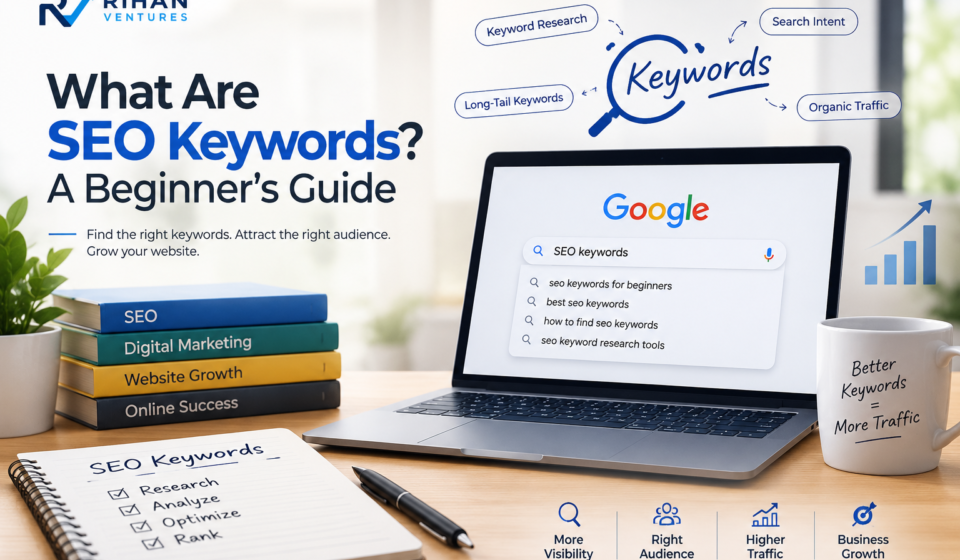

in today’s digital world, having a website is not enough to attract visitors. You also need to help people find your website through search engines like Google. This is where SEO keywords play an important role.

SEO keywords are the words and phrases people type into search engines when looking for information, products, or services. By understanding and using the right SEO keywords, website owners can improve their search visibility, attract relevant visitors, and grow their online presence.
Whether you are a beginner, blogger, entrepreneur, or business owner, learning how SEO keywords work can help you create useful content that matches what your target audience is searching for.
At Rihan Ventures, we believe that understanding SEO fundamentals is an important step towards building a successful online business. In this beginner’s guide, you will learn what SEO keywords are, why they matter, how to find them, and how to use them effectively.
What Are SEO Keywords?
SEO keywords are specific words or phrases that describe the content of a webpage and match the search terms people use on search engines.
For example, if someone wants to learn about digital marketing, they might search for phrases such as:
- What is digital marketing?
- Digital marketing for beginners
- Best digital marketing strategies
- How to grow a business online
These phrases can be potential SEO keywords for articles about digital marketing.
When you understand the search terms your audience uses, you can create content that answers their questions and meets their needs.
Example: If you run a website about digital marketing, using relevant SEO keywords in your articles can help search engines understand your content and determine when it may be useful to searchers.
Why Are SEO Keywords Important?
SEO keywords help connect your website’s content with people searching for related information.
Here are some important benefits of using SEO keywords:
Improve Search Engine Visibility
Relevant keywords help search engines understand what your webpage is about. Well-optimised, helpful content may have a better opportunity to appear in relevant search results.
Attract the Right Audience
Choosing relevant SEO keywords can help bring visitors who are genuinely interested in your topic, products, or services.
Understand Your Audience
Keyword research reveals the questions and problems people are searching for online. You can use these insights to plan useful blog posts.
Support Business Growth
For businesses, relevant organic traffic can create opportunities to generate leads, build trust, and attract potential customers.
Build a Strong Content Strategy
SEO keywords help you organise your website around topics your audience cares about, making it easier to plan future articles.
Remember, using SEO keywords alone does not guarantee higher rankings. Content quality, search intent, website performance, and other SEO factors also matter.
What Are the Different Types of SEO Keywords?
Understanding the different types of SEO keywords helps you choose the right phrases for your website.
Short-Tail Keywords
Short-tail keywords are broad search phrases that usually contain one to three words.
Examples:
- SEO
- Digital marketing
- Website design
- Online business
These keywords can have high search demand, but they are often competitive and may not clearly indicate what the searcher wants.
Long-Tail Keywords
Long-tail keywords are more specific search phrases that often contain three or more words.
Examples:
- SEO tips for beginners
- How to find SEO keywords for a blog
- Affordable website design for small businesses
- How to improve website ranking on Google
Long-tail SEO keywords can help you target a more specific audience and create content that answers a particular question.
Informational Keywords
Informational keywords are used when people want to learn something.
Examples:
- What are SEO keywords?
- How does SEO work?
- What is keyword research?
These keywords are useful for educational blog posts and beginner’s guides.
Commercial Keywords
Commercial keywords are used when people are researching products or services before making a decision.
Examples:
- Best SEO tools for beginners
- WordPress hosting comparison
- Best website builders for small businesses
These keywords are useful for comparison articles and product research content.
Transactional Keywords
Transactional keywords indicate that someone may be ready to take action or make a purchase.
Examples:
- Buy website hosting
- Hire an SEO agency
- Purchase a WordPress theme
The best keyword type depends on your website’s goals and the needs of your audience.
How Can You Find the Right SEO Keywords?
Finding the right SEO keywords is an important part of search engine optimisation. Follow these steps to start your keyword research.
Step 1: Understand Your Target Audience
First, identify the people you want to reach. Consider their interests, questions, problems, and goals.
For example, if your website helps beginners learn digital marketing, your audience might search for:
- SEO basics for beginners
- How to start a blog
- How to build a business website
- Digital marketing tips
Step 2: Use Google Search Suggestions
Start typing a topic into Google and observe the suggestions that appear. These suggestions can provide ideas about the phrases people may search for.
You can also review Google’s related searches and the questions displayed in search results.
Treat these suggestions as research ideas rather than proof of search volume.
Step 3: Use Keyword Research Tools
Keyword research tools can help you discover related keywords and evaluate their estimated search volume and competition.
Some popular options include:
- Google Keyword Planner
- Google Trends
- Ahrefs
- Semrush
- Ubersuggest
Some tools offer free features, while others require a paid subscription.
Step 4: Check Search Intent
Search intent means the reason behind a search.
Ask yourself what someone expects to find when searching for your keyword.
For example, a person searching for “What are SEO keywords?” probably wants an explanation, not a page selling SEO services.
Your content should match that expectation.
Step 5: Evaluate Competition and Relevance
Choose SEO keywords that are closely related to your topic and realistic for your website to target.
Review the pages currently ranking for your chosen phrase. Consider whether you can create a clearer, more useful, and more complete answer.
Do not choose keywords based only on estimated search volume. Relevance and search intent are equally important.
How Should You Use SEO Keywords in a Blog Post?
After finding relevant SEO keywords, place them naturally in important parts of your content.
Include Your Main Keyword in the Title
Use your primary keyword in the page title when it fits naturally.
Example: “What Are SEO Keywords? A Beginner’s Guide.”
Write a clear introduction.
Introduce the topic and explain what readers will learn. Include your primary keyword naturally in the opening paragraph.
Use keywords in headings.
Include your main keyword or relevant variations in headings where they accurately describe the section.
For example:
- What Are SEO Keywords?
- How to Find SEO Keywords
- Why Are SEO Keywords Important?
Avoid repeating the same phrase in every heading.
Create a Helpful URL Slug.
Keep the URL short, descriptive, and easy to understand.
Example:
/seo-keywords-guide/
Write a Useful Meta Description.
A meta description briefly explains what readers can expect from your page. It can help searchers decide whether to visit your website.
Example:
“Learn what SEO keywords are, explore different keyword types, and discover how to find and use the right keywords to improve your website’s SEO.”
Add Relevant Internal Links
Link to other useful articles on your website when they provide additional information.
For example, this article could link to your existing guides about SEO and digital marketing.
Internal links help readers discover related content and help search engines understand the relationships between pages.
Use Related Keywords Naturally
You can also include related phrases such as
- Keyword research
- Search intent
- Organic traffic
- On-page SEO
- Search engine optimisation
These phrases add context and help you cover the topic comprehensively.
What Is Keyword Density, and How Much Is Enough?
Keyword density refers to how frequently a particular keyword appears in a piece of content relative to the total number of words.
For example, if the phrase “SEO keywords” appears 10 times in a 1,000-word article, its approximate exact-match keyword density is 1%.
However, there is no universally required keyword density that guarantees a higher Google ranking.
Instead of forcing SEO keywords into every paragraph, focus on writing naturally and answering the reader’s questions thoroughly.
Excessive repetition can make an article difficult to read and may be considered keyword stuffing.
Best practice: Use your main keyword in relevant locations, include related terms naturally, and prioritise useful information over a specific keyword-density percentage.
What Are Common SEO Keyword Mistakes to Avoid?
Beginners sometimes make mistakes when researching and using SEO keywords.
Here are some common problems to avoid.
Keyword Stuffing
Repeating the same keyword unnaturally can harm readability. Use SEO keywords only where they make sense.
Ignoring Search Intent
A keyword may look attractive, but your article will struggle to satisfy readers if it does not answer their actual question.
Targeting Only Highly Competitive Keywords
New websites may find it difficult to compete for broad terms. Specific, relevant long-tail keywords can be a useful starting point.
Using Irrelevant Keywords
Do not include popular keywords simply to attract traffic. Your content should remain relevant to your website and audience.
Forgetting to Update Content
Search behaviour and information can change. Review important articles periodically and update outdated details.
Expecting Immediate Results
SEO often takes time. Publishing helpful content consistently and monitoring performance can help you understand what works for your website.
How Can You Track the Performance of SEO Keywords?
Once your content is published, monitor how it performs in search results.
Two useful tools are Google Search Console and Google Analytics.
Google Search Console
Google Search Console helps you understand how your website performs in Google Search.
You can review information such as:
- Search queries that generate impressions
- Clicks from Google Search
- Click-through rate
- Average search position
- Indexing issues
This information can help you identify SEO keywords that are already bringing visibility to your website.
Google Analytics
Google Analytics can help you understand how visitors interact with your website.
Depending on your setup, you can examine:
- Website traffic
- Visitor engagement
- Landing-page performance
- Traffic sources
- Important conversions
Use these insights to improve your content strategy and make better decisions about future blog posts.
How Can Beginners Create an Effective SEO Keyword Strategy?
You do not need to target hundreds of keywords at once. Start with a simple, organised plan.
Follow these steps:
- Choose a main topic related to your website.
- Research relevant SEO keywords.
- Identify the search intent behind each keyword.
- Select one primary keyword for each article.
- Group closely related questions into useful sections.
- Create original content that answers those questions.
- Add relevant internal links.
- Publish and check that the page can be indexed.
- Monitor performance in Google Search Console.
- Improve the article based on what you learn.
For example, Rihan Ventures can build a beginner-friendly content series covering SEO keywords, keyword research, on-page SEO, backlinks, website optimisation, and digital marketing.
Publishing related articles can help readers explore your website and develop a better understanding of digital marketing.
Conclusion
SEO keywords are an essential part of understanding how people search for information online. They help website owners identify audience interests, plan relevant content, and communicate a webpage’s subject to search engines.
To use SEO keywords effectively, begin with keyword research, understand search intent, choose relevant phrases, and create useful content that answers real questions.
Avoid keyword stuffing and do not focus exclusively on keyword density. Instead, prioritise readability, originality, relevance, and a positive user experience.
At Rihan Ventures, our goal is to help beginners and business owners understand digital marketing and build a stronger online presence. Start applying these SEO keyword practices to your website, monitor your results, and keep improving your content over time.
Frequently Asked Questions (FAQs)
1. What are SEO keywords in simple words?
SEO keywords are words and phrases people enter into search engines to find information, products, or services. Website owners use relevant keywords to plan and optimise content for their target audience.
2. Why are SEO keywords important for a website?
SEO keywords help you understand what your audience is searching for and create relevant content. They can support search visibility and help attract visitors who are interested in your topic.
3. How do I find SEO keywords for free?
You can find SEO keywords using Google Search suggestions, related searches, Google Trends, Google Keyword Planner, and Google Search Console. These tools provide different types of keyword ideas and performance information.
4. How many SEO keywords should I use in one article?
There is no fixed number. Choose one primary keyword and use relevant supporting keywords where appropriate. The number depends on the article’s length, topic, and scope.
5. What is the difference between short-tail and long-tail SEO keywords?
Short-tail keywords are broad phrases such as “SEO” or “digital marketing”. Long-tail keywords are more specific phrases, such as “SEO tips for small business websites.” Long-tail keywords often communicate clearer search intent.
6. What is keyword density in SEO?
Keyword density is the proportion of a page’s words made up by a particular keyword. There is no universal ideal percentage for Google rankings. Natural, useful writing is more important than reaching an arbitrary density target.
7. Can SEO keywords improve Google rankings?
Relevant SEO keywords can help search engines understand your content, but they do not guarantee rankings. Helpful content, search intent, technical SEO, competition, and other factors also influence performance.
8. How long does it take for SEO keywords to show results?
The time varies depending on your website, competition, content quality, and other factors. It can take weeks or months to see meaningful changes, and some pages may take longer.
9. What are the best SEO keywords for beginners?
The best SEO keywords are relevant to your audience, match their search intent, and offer a realistic opportunity for your website. Specific long-tail phrases can be a useful starting point for new websites.
10. Which tools are best for SEO keyword research?
Popular keyword research tools include Google Keyword Planner, Google Trends, Ahrefs, Semrush, and Ubersuggest. The best choice depends on your research needs and budget.
Visit Home rihanventure.online